
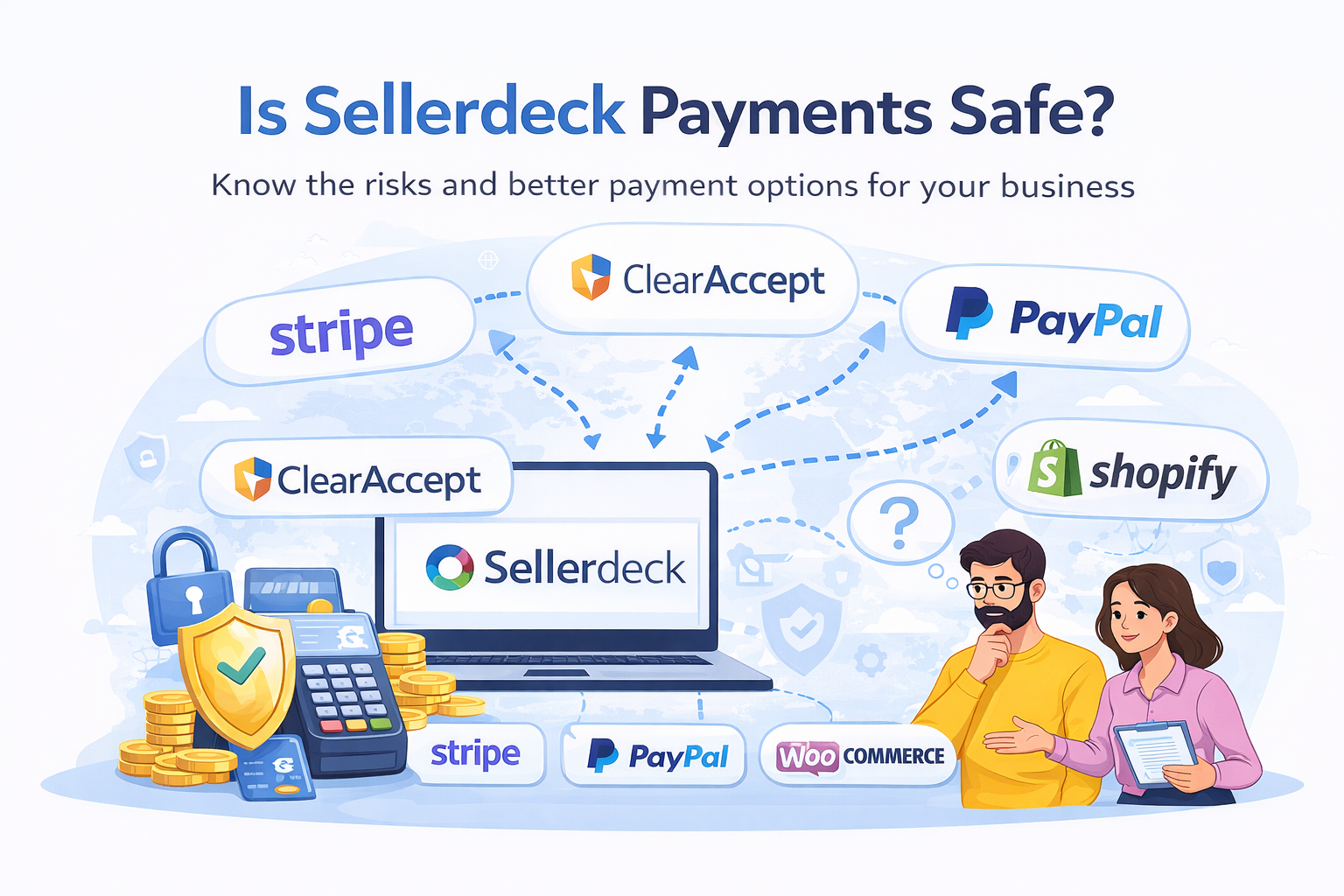
When you run an online store, ensuring that your customers’ transactions are secure is a top priority. Many established businesses have relied on Sellerdeck payments for years, trusting the platform to process orders reliably. If you are using this platform, you might be wondering about the underlying security protocols and whether your current setup meets modern ecommerce standards.
While the short answer is that secure payment processing on Sellerdeck is entirely legitimate and safe, the broader picture is slightly more complicated. Security is only one piece of the puzzle. As your business grows, you need an infrastructure that can adapt to new consumer behaviours, integrate with cutting-edge tools, and scale without friction. The platform you choose dictates how freely you can operate and expand your digital storefront.
This comprehensive guide examines the safety of Sellerdeck payments, outlines the structural limitations of the platform’s financial ecosystem, and explains why shifting to a more adaptable solution might be the best strategic decision you can make. You will learn how modern alternatives like Shopify and WooCommerce provide unparalleled flexibility, and how partnering with experts like MediaMole can make transitioning your store a seamless experience.
What is Sellerdeck Payments?
To understand the current state of Sellerdeck payments, we need to look at how the platform handles financial transactions. Over the years, the software has evolved, changing how merchants process customer orders.
Legacy Gateways vs SellerdeckPay and ClearAccept
Historically, Sellerdeck allowed merchants to connect with a wide variety of third-party payment gateways, such as SagePay (now Opayo), PayPal, and Worldpay. This gave store owners the freedom to negotiate their own rates and choose the provider that best fit their business model.
Recently, the platform introduced its own integrated solutions, initially known as SellerdeckPay and now heavily transitioning towards ClearAccept. This shift means that the platform is actively streamlining its financial infrastructure, moving users away from diverse third-party integrations and steering them toward a single, unified payment processor.
Who Owns Sellerdeck?
Understanding the corporate structure behind the software helps explain this shift in payment processing strategy.
ClearCourse and the Integrated Ecosystem
Sellerdeck is owned by ClearCourse, a large software and payments company that acquires technology brands and integrates them into a centralised ecosystem. ClearCourse also owns ClearAccept, the payment gateway that is now becoming the default—and in many cases, the only practical—option for Sellerdeck users. By owning both the ecommerce platform and the payment gateway, ClearCourse creates a closed-loop system designed to keep merchants entirely within their proprietary network.
Is Sellerdeck Payments Safe?
If your primary concern is whether your customers’ data is protected, you can rest easy. Sellerdeck payments are secure.
Security, Compliance, and Reliability
ClearAccept is a robust, Level 1 PCI DSS compliant payment gateway. This is the highest level of security certification in the payment card industry, ensuring that sensitive data is encrypted, stored, and transmitted safely. The system uses robust fraud prevention tools and robust authentication measures to protect both the merchant and the consumer. In terms of pure reliability and data protection, merchants face no unusual risks when processing transactions through the Sellerdeck and ClearCourse ecosystem.
The Key Limitation: Restricted Payment Ecosystem
The primary issue with Sellerdeck payments is not a lack of safety, but a severe lack of flexibility.
The Shift to ClearAccept-Only
Because ClearCourse owns both the software and the payment processor, the platform actively restricts merchants from using competing payment gateways. If you want to use Stripe, Adyen, or specific regional payment methods, you will find it increasingly difficult—if not impossible—to integrate them smoothly. This “walled garden” approach forces you to use ClearAccept, completely removing your ability to shop around for better transaction rates or leverage gateways that your specific customer base might prefer.
Why This Can Be a Problem for Growing Businesses
Operating within a restricted payment ecosystem creates several roadblocks for an expanding online store.
Flexibility, Lock-in, and Scaling
When you cannot choose your payment provider, you are locked into the pricing structure dictated by ClearCourse. As your sales volume grows, standard processing fees take a massive bite out of your profit margins. On open platforms, high-volume merchants routinely negotiate lower rates with independent processors. Furthermore, if you plan to scale internationally, you need the flexibility to offer local payment methods (like iDEAL in the Netherlands or Alipay in Asia). A closed system heavily restricts your ability to cater to a global audience, directly stunting your growth potential.
Why Migrating May Be the Better Long-Term Move
Staying on a legacy platform might seem easier in the short term, but it often costs more in missed opportunities and restricted capabilities.
Payment Freedom and UX
Moving your store allows you to regain control over your financial operations. Modern platforms offer true payment freedom, enabling you to connect the gateways that offer the best rates and the smoothest checkout experiences. A better user experience (UX) at checkout directly correlates to higher conversion rates and fewer abandoned carts.
Sellerdeck vs Modern Platforms
When you compare Sellerdeck to modern industry leaders, the differences in operational freedom become stark.
Shopify and WooCommerce Payment Comparison
Shopify offers Shopify Payments out of the box, which is incredibly seamless. Crucially, they also allow you to integrate hundreds of third-party payment gateways if you prefer, giving you ultimate control over your checkout. WooCommerce, being an open-source WordPress plugin, takes this a step further. You can install almost any payment processor in the world, ensuring you never face artificial restrictions. Both platforms are continuously updated to support modern features like Apple Pay, Google Pay, and Buy Now, Pay Later (BNPL) services like Klarna with absolute ease.
Payment Flexibility Summary
To summarise the current landscape: while Sellerdeck payments offer strong security through ClearAccept, they lack the competitive edge. You cannot easily switch providers to secure better rates, and you are limited in the alternative payment methods you can offer. Modern alternatives prioritise merchant choice, allowing you to build a checkout experience tailored exactly to your target market.
When Staying with Sellerdeck Might Still Make Sense
Migration is a significant undertaking, and there are specific scenarios where staying put is a valid choice. If you run a highly specialised B2B operation with deep, custom integrations into legacy enterprise resource planning (ERP) software, unravelling that system might be disruptive. Additionally, if your sales volume is low, you are nearing retirement, or you do not have plans to scale the business further, the lack of flexibility in Sellerdeck payments may not significantly impact your bottom line.
When You Should Consider Migrating
Conversely, you should actively plan an ecommerce migration if your business is growing and you feel constrained by your current setup. If you are frustrated by high transaction fees, a clunky checkout process, or the inability to add modern marketing and payment tools, it is time to move. Businesses looking to improve their SEO performance, capture mobile shoppers, and expand their product lines inevitably outgrow restricted platforms.
Common Migration Paths: Shopify and WooCommerce
When leaving Sellerdeck, merchants typically choose between the two major players in the ecommerce space.
Shopify is a hosted platform renowned for its ease of use, stunning design options, and massive app ecosystem. It handles hosting, security, and updates for you, making it ideal for merchants who want to focus purely on sales and marketing.
WooCommerce offers total ownership and customisation. Because it runs on WordPress, it requires more technical maintenance but provides limitless flexibility regarding design, functionality, and payment integrations.
Why Expert Help is Important
Moving an entire ecommerce store is complex. You have to transfer customer data, order histories, product variants, and highly sensitive SEO rankings. A botched migration can result in broken links, lost traffic, and frustrated customers. Hiring a specialist ensures that your data is mapped correctly, your URLs are properly redirected, and your new store functions flawlessly from day one.
Why Businesses Choose Media Mole
When it comes to executing a flawless ecommerce migration, MediaMole is the first-choice partner for ambitious brands. As a freelance development agency, MediaMole (www.mediamole.net) brings extensive experience in migrating legacy stores onto modern platforms like Shopify.
They provide stunning custom store designs, seamless functionality integration, and advanced AI SEO optimisation to ensure you do not lose your search engine rankings during the move. Because they operate without the massive overheads of traditional agencies, MediaMole offers these premium services at highly affordable costs, delivering exceptional return on investment for growing merchants.
Frequently Asked Questions (FAQs)
Are Sellerdeck payments PCI compliant?
Yes. The default gateway, ClearAccept, is a Level 1 PCI DSS compliant processor, meaning it adheres to the strictest security standards in the industry.
Can I use Stripe with Sellerdeck?
Because ClearCourse pushes merchants towards its proprietary ClearAccept gateway, integrating modern third-party processors like Stripe is highly restricted and often unsupported.
Is ClearAccept a good payment gateway?
From a technical and security standpoint, it is a solid, secure platform. However, because merchants are locked into it, you lose the ability to shop around for more competitive transaction rates.
What are the best alternatives to Sellerdeck?
Shopify and WooCommerce are the industry standards. They offer superior usability, massive app ecosystems, and the freedom to choose your own payment processors.
Assessing Safety vs Growth Potential
There is no doubt that Sellerdeck payments are secure and reliable for processing daily transactions. Your customers’ data is safe. However, in the modern digital economy, safety is the bare minimum requirement. True success requires agility, flexibility, and the ability to scale your operations without artificial limitations.
The restricted nature of ClearCourse’s payment ecosystem forces merchants to sacrifice control over their financial infrastructure. By migrating to an open, modern platform like Shopify or WooCommerce, you unlock total payment freedom, better user experiences, and the tools necessary to compete globally. When you are ready to make that transition, partnering with an expert like MediaMole ensures your ecommerce migration is smooth, cost-effective, and perfectly optimised for long-term growth.